

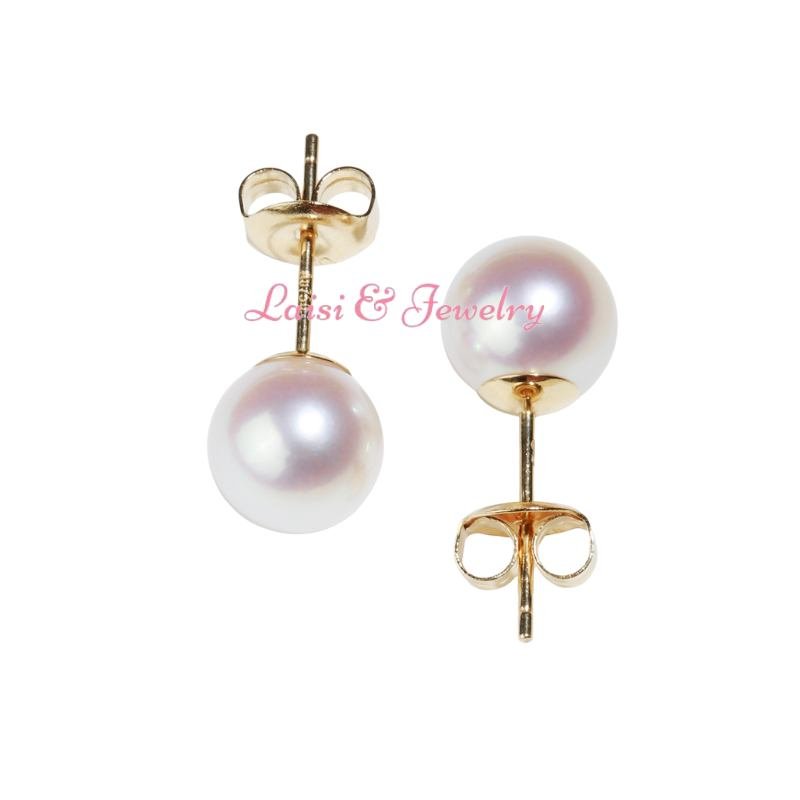
Cultured pearls are real pearls. They form in a living mollusk after human intervention begins the growth process. Imitation pearls are beads made to look like pearls, commonly using glass, plastic, shell, or composite materials. Some clues can help you ask better questions, but no simple home test can provide complete identification in every case.
Real, Cultured, Natural, and Imitation: Know the Terms
- Natural pearl: forms without intentional human intervention.
- Cultured pearl: forms in a mollusk with human assistance. It is a real pearl.
- Imitation pearl: a manufactured bead designed to resemble a pearl but made from another material.
- Treated pearl: a real pearl whose appearance may have been altered. Treatment disclosure matters when it affects a purchase decision.
The Gemological Institute of America confirms that cultured pearls are real pearls.
Clues You Can Observe Before Buying
Look for depth in the luster
Real nacre can create bright reflections with visual depth, while some imitations appear uniformly glossy or flat. However, high-quality imitation coatings can look convincing, and lower-luster real pearls exist, so this clue is not conclusive.
Compare the surfaces
Real pearls often show small variations in shape, color, or surface. Identical perfection across every bead may deserve closer inspection, but well-matched cultured strands exist and imitation beads can also be intentionally varied.
Inspect drill holes and worn areas
On some imitations, coating may collect, chip, or reveal a different material around the drill hole. Real pearls can also be damaged or worn, so do not scrape, cut, or otherwise harm jewelry to test it.
Read the product wording carefully
Look for a clear pearl type, such as freshwater cultured pearl or Akoya cultured pearl. Terms such as “pearl-like,” “simulated,” or “faux” indicate imitation. “Mother-of-pearl” describes shell material and is not the same as a cultured pearl.
What About the Tooth Test?
You may see advice to rub a pearl gently against a tooth and interpret a gritty sensation as real nacre. This is not a complete or reliable identification method, can be unhygienic, and may risk damage. It should never replace disclosure, documentation, or professional testing.
Why Professional Testing Matters
Visual observation cannot always determine whether a pearl is natural or cultured, freshwater or saltwater, treated or untreated. GIA explains that laboratories use digital X-radiography, visual observation, and advanced equipment to examine pearl structure. Microradiography is a reliable non-destructive method for viewing internal structure.
Professional identification is most relevant for valuable, antique, inherited, or disputed pieces. Ask an independent qualified gemologist or recognized gemological laboratory about the appropriate service. A retailer’s product description is useful, but it is not automatically an independent laboratory report.
A Safer Pearl Buying Checklist
- Buy from a seller that clearly names the pearl material and jewelry metal.
- Check size, shape, color, and multiple product photographs.
- Read the return policy before ordering.
- Ask whether treatments are disclosed when color or value makes that relevant.
- Do not assume every cultured pearl includes a certificate.
- For high-value identification, rely on an independent laboratory rather than a home test.
Real Pearl FAQ
Are cultured pearls fake?
No. Cultured pearls are real pearls grown in mollusks with human assistance. Imitation pearls are manufactured from other materials.
Can real pearls be perfectly round?
Yes. Round cultured pearls exist and can be carefully matched. Perfect uniformity is not proof that pearls are imitation, just as irregularity alone does not prove they are real.
Can a photograph prove pearls are real?
No. Photographs can show appearance but cannot reliably reveal internal structure or every treatment. Laboratory analysis may be needed for a definitive high-value identification.
Related reading: What Makes a Pearl Valuable? and Freshwater Pearls vs Akoya Pearls.
